 Leo

If you hate making cheesecake, you are going to love this recipe.
Traditional New York-style cheesecake is a nightmare for a home baker. You have to make a crust, you have to carefully beat the eggs on low speed so it doesn’t crack, and you have to wrap the pan in tin foil and bake it in a terrifying, sloshing water bath. If you mess up any of those steps, the cake is ruined.
The Burnt Basque Cheesecake completely throws all of those rules in the garbage.
There is no crust. There is no water bath. You want it to crack. You want the top to literally burn and scorch in the oven. It is the ugly, chaotic, wildly delicious cousin of traditional cheesecake. Because it is baked at a blazing hot temperature, the outside caramelizes into a dark, slightly bitter shell that tastes like toasted marshmallows, while the inside stays aggressively creamy and almost liquid in the dead center.
However, most Basque cheesecake recipes require a massive springform pan and four pounds of cream cheese. I don’t always want to make a thirty-dollar, five-pound cake.
That is why I started making it in a standard loaf pan. Scaling it down to fit a loaf pan means you only need two blocks of cream cheese. It bakes faster, it is easier to slice into thick, beautiful rectangles, and it is the perfect size for a small dinner party.
If you are a traditionalist and actively want to build a crust and use a water bath, go make my Gingerbread Cheesecake with Molasses Cookie Crust. If you want an impossibly light vanilla cake instead, check out my Vanilla Magic Custard Cake. But if you are ready to intentionally burn a dessert and look like a genius doing it, grab your loaf pan.
🧀 Bake Time · Loaf Pan Dessert · 8 Slices
Prep time: 15 min · Bake time: 35 min · Chill time: 4 hrs · Calories: 380 kcal
The Loaf Pan Math (Macros & Calories)
Just because we scaled this down to fit a loaf pan doesn’t mean it is a diet food. It is still a solid brick of heavy cream and full-fat cheese. Here is the estimated breakdown per slice (assuming you cut the loaf into 8 very thick slices):
- Calories: 380
- Protein: 6g
- Carbohydrates: 22g
- Dietary Fiber: 0g
- Total Sugars: 20g
- Fat: 31g
- Saturated Fat: 18g
- Sodium: 190mg
If these numbers are making you panic, you need to exit this page and go make my High Protein Cheesecake Fluff instead. If you are making a Basque cheesecake, you must commit to the heavy cream. If you use skim milk, the cake will curdle and taste like a burnt sponge.
The “Crumpled Paper” Rule
This is the defining visual characteristic of a Basque cheesecake. You do not grease the pan, and you do not cut a perfectly neat square of parchment paper to line the bottom.
You need the parchment paper to violently stick up over the edges of the pan to protect the sides of the cake from burning too fast, and to hold the batter in when it puffs up in the oven.
The Trick: Cut a massive sheet of parchment paper. Run the entire sheet of paper briefly under cold tap water from your sink. Squeeze it into a tight ball so it gets completely wrinkled and crumpled. Shake the excess water off, un-crumple it, and press the wet paper directly into the loaf pan. The water makes the stiff paper pliable, allowing it to easily push into the corners of the pan without tearing. Those messy, rustic wrinkles on the sides of the cake are exactly what you want. I use the exact same loaf pan lining trick when I bake my Apple Fritter Bread (Viral Cinnamon-Apple Quick Bread).
The Ingredient Lineup
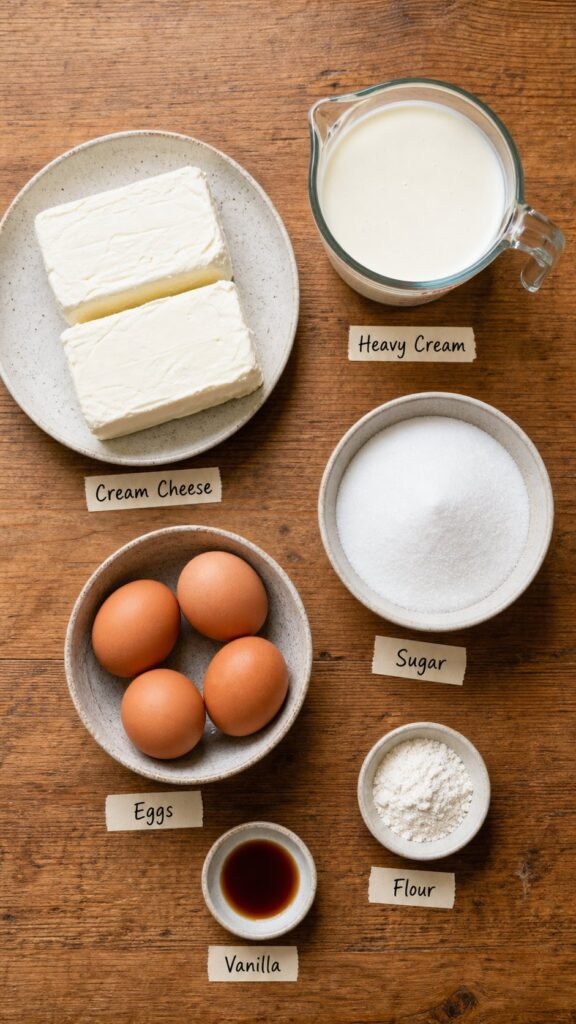
The Cheesecake Batter:
- 16 oz (two 8-oz blocks) full-fat cream cheese, completely softened
- 3/4 cup granulated sugar
- 3 large eggs, room temperature
- 1 cup heavy whipping cream, room temperature
- 1 teaspoon vanilla extract
- 1/2 teaspoon fine sea salt
- 2 tablespoons all-purpose flour
The Cream Cheese: You must use full-fat, brick-style cream cheese (like Philadelphia). Do not use the whipped cream cheese that comes in a plastic tub; it has too much air in it, and your cake will collapse. Do not use fat-free cream cheese, or the cake will not set.
The Flour: We use exactly two tablespoons of flour. It acts as a stabilizer. Without a crust, the cheesecake needs just a tiny bit of structure to hold itself together when you slice it. If you need it to be gluten-free, you can swap the flour for 1 tablespoon of cornstarch.
Beat, Pour, Burn
1. Prep the pan and the oven.
Preheat your oven as hot as it will go without turning on the broiler. You want it at 400°F (200°C).
Take your massive sheet of parchment paper, crumple it under running water, ring it out, and press it aggressively into your 9×5-inch metal loaf pan.
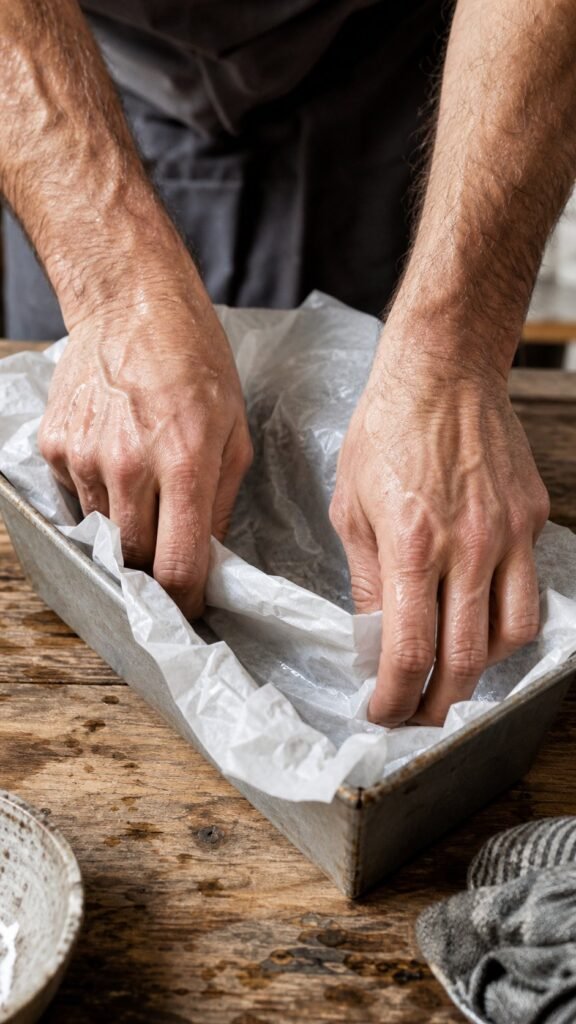
Leave plenty of paper hanging over the edges.
2. Beat the cheese and sugar.
In a large bowl, use an electric hand mixer to beat the softened cream cheese and the granulated sugar.
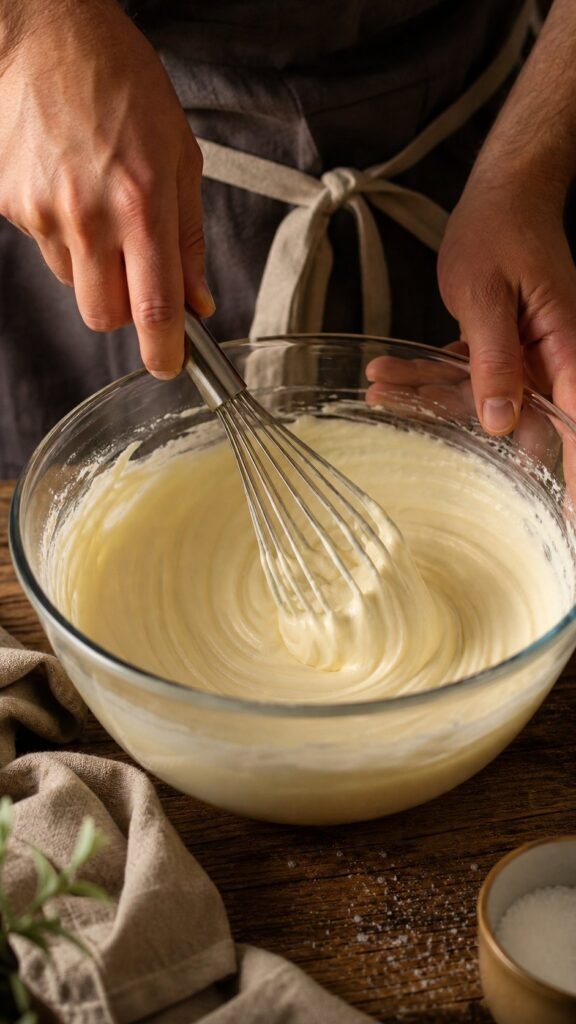
Do this on medium speed for a full two minutes. You want to beat the sugar into the cheese until it is completely smooth and you can no longer feel the gritty sugar crystals. If your cream cheese was cold, it will be lumpy. You cannot fix lumpy batter. Soften the cheese first.
3. Add the eggs.
Add the room-temperature eggs one at a time. Mix on low speed just until the yolk disappears. You do not want to whip a ton of air into the batter at this stage. Add the vanilla extract and the salt.
4. The heavy cream and flour.
In a separate small bowl or liquid measuring cup, whisk the heavy whipping cream and the two tablespoons of flour together until the flour is completely dissolved. If you dump dry flour directly into the cream cheese, it will form tiny, disgusting white lumps.
Pour the cream and flour mixture into the main bowl. Mix on low speed for 30 seconds just until the batter is smooth, thin, and velvety.
5. Pour it in.
Pour the smooth batter directly into your crumpled parchment-lined loaf pan.
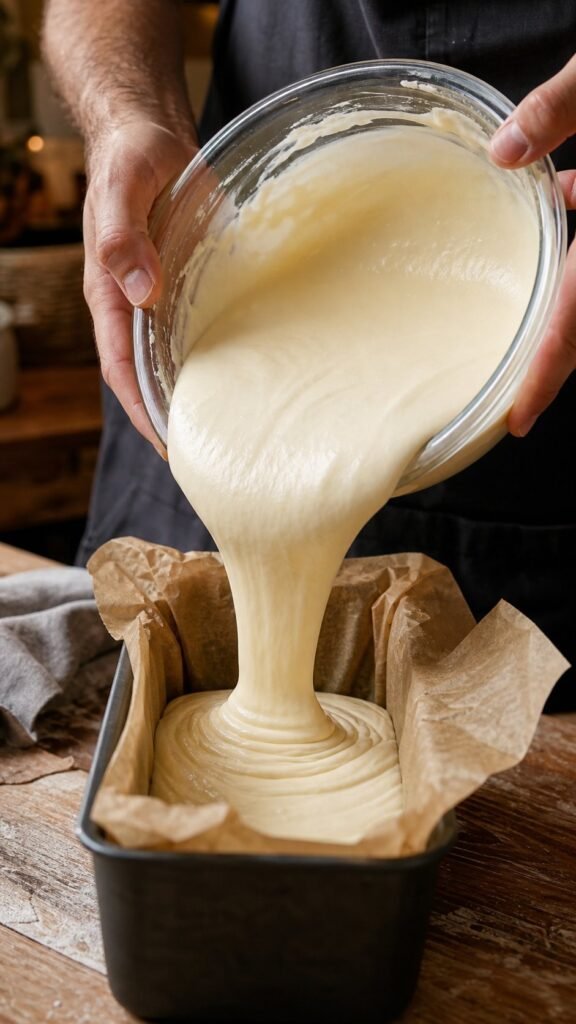
Tap the pan aggressively against your kitchen counter three or four times. This forces any massive, trapped air bubbles to rise to the surface and pop.
6. The Intentional Burn.
Bake at 400°F (200°C) for 30 to 35 minutes.
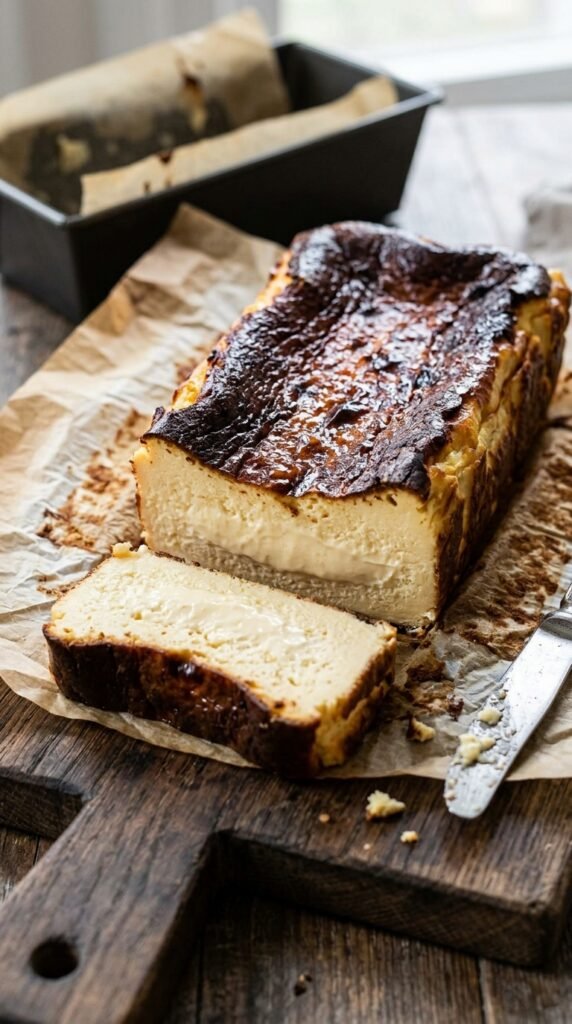
You have to watch it carefully at the end. You want the top of the cake to be a deep, dark, scorched mahogany brown—almost black in some spots. It will look burnt. It is supposed to look burnt.
However, the center of the cake must still have a violent, liquid jiggle when you shake the pan. The edges should look set and puffed up, but the dead center should look like a waterbed. If the center is totally firm, you overbaked it.
7. The Collapse and Chill.
Pull the pan out of the oven. Do not touch it. As it cools on the counter, the puffed-up cake will drastically collapse and sink in the middle. This is entirely normal. Let it sit on the counter for an hour, then transfer the pan to the fridge. It must chill for at least 4 hours (preferably overnight) so the liquid center can set into a gooey, sliceable custard.
My Burnt Cheesecake Catastrophes
The first time I made this, I panicked. I stared through the oven glass at the 25-minute mark and saw the top turning dark black. I got scared and pulled it out. Because I pulled it before the 35-minute mark, the center of the cake never reached the proper temperature. When I cut into it hours later, it wasn’t gooey; it was literally raw, runny egg soup that flooded my plate. Embrace the burn. Trust the timer.
My second mistake was trying to serve it straight out of the fridge. Because this cake doesn’t have a crust, cold Basque cheesecake feels dense, rubbery, and heavy in your mouth. You have to let it sit on the counter for an hour before serving so it returns to room temperature and softens back into a creamy melt-in-your-mouth texture.
Loaf Pan Troubleshooting
Why did my cake taste like scrambled eggs?
You overbaked it. If you leave a Basque cheesecake in a 400-degree oven for 50 minutes, the eggs in the batter will physically scramble. The texture will be grainy and spongy instead of creamy. Pull it when it is still aggressively jiggling.
The top of my cake didn’t burn at all!
Every oven runs differently. If you hit the 35-minute mark, your cake is jiggling perfectly, but the top is still pale yellow, your oven runs cold. Do not leave the cake in the oven to bake longer, or you will ruin the center. Instead, turn your oven to the “Broil” setting for exactly 60 to 90 seconds. Stand there and watch it. The broiler will scorch the top of the cake instantly without overcooking the inside.
Why did my parchment paper catch on fire?
Parchment paper is safe up to 425°F, but if you have massive, dry flaps of paper sticking four inches up over the pan, they can brush against the heating element or the broiler and singe. Trim the excess paper so it only hangs about an inch over the rim of the loaf pan.
Storage & Serving Rules
Because this is a dairy-heavy dessert, it must be stored in the fridge.
The Countertop Rule: I am repeating this because it is that important. Store the cake in the fridge, but do not eat it cold. Pull your slices out of the fridge 45 minutes before you plan to eat them. Room-temperature Basque cheesecake is what gives you that signature, gooey, molten center.
Shelf Life: Keep the cake wrapped tightly in plastic wrap in the fridge for up to 4 days. Do not freeze this cake. The texture relies entirely on the heavy cream and eggs being emulsified. Freezing it causes the dairy to separate, and when it thaws, the cake will weep water and turn grainy.
Flavor Tweaks
The Espresso Basque: Add one tablespoon of instant espresso powder to the heavy cream when you whisk in the flour. It turns the entire cheesecake into a dark, roasted coffee dessert that pairs unbelievably well with the burnt, caramelized top.
Orange Zest: Grate the zest of one large, fresh orange directly into the cream cheese and sugar when you beat them together. The citrus oils cut through the massive amount of heavy cream perfectly. I use this exact same citrus trick in my Easy One-Bowl Lemon Dessert.
The Chocolate Core: If you want a messy, molten chocolate center, chop up half a cup of dark chocolate chips. Pour half the cream cheese batter into the pan, scatter the chocolate chunks directly down the middle, and pour the rest of the batter over the top. The heat of the oven melts the chocolate into a lava core.
Burnt Basque Cheesecake
No crust, no water bath, you want it to burn. Baked at 400°F in a loaf pan — dark scorched shell outside, aggressively creamy custard inside. Two blocks of cream cheese, not four pounds.
Ingredients 01
Do not grease the pan. Do not cut a neat parchment square. Cut a massive sheet of parchment paper, run it briefly under cold tap water, squeeze into a tight ball until completely wrinkled, shake off excess water, un-crumple, and press directly into the 9×5-inch metal loaf pan. Leave plenty hanging over the edges. The water makes stiff paper pliable so it pushes into corners without tearing. Those messy rustic wrinkles on the sides of the cake are exactly what you want.
As an Amazon Associate, we may earn from qualifying purchases. Click any ingredient name to shop it on Amazon — no extra cost to you.
How to Cook 02
Preheat oven as hot as it will go without broiler — 400°F (200°C). Take a massive sheet of parchment paper, crumple it under running water, ring it out, and press aggressively into your 9×5-inch metal loaf pan. Leave plenty of paper hanging over the edges.
In a large bowl, beat softened cream cheese and granulated sugar with an electric hand mixer on medium speed for a full 2 minutes. Beat until completely smooth — you cannot feel gritty sugar crystals. If cream cheese was cold, batter will be lumpy and you cannot fix lumpy batter. Soften the cheese first.
Add room-temperature eggs one at a time. Mix on low speed just until each yolk disappears — do not whip air into the batter. Add vanilla extract and salt.
In a separate small bowl or measuring cup, whisk 1 cup heavy whipping cream + 2 Tbsp flour until flour is completely dissolved — do not dump dry flour directly into cream cheese or you’ll get disgusting white lumps. Pour into main bowl. Mix on low for 30 seconds till batter is smooth, thin, velvety.
Pour batter directly into crumpled parchment-lined loaf pan. Tap pan aggressively against countertop 3–4 times to force trapped air bubbles to surface and pop.
Bake at 400°F (200°C) for 30–35 minutes. Watch carefully at the end. Top must be deep dark scorched mahogany brown — almost black in spots. It looks burnt. It is supposed to. Center must still have a violent liquid jiggle when you shake the pan — edges set and puffed, dead center like a waterbed. If center is totally firm, you overbaked it. If top is pale at 35 minutes but center jiggles, use broiler for 60–90 seconds — watch it constantly.
Pull from oven. Do not touch. As it cools on counter, puffed cake will drastically collapse and sink in middle — entirely normal. Sit on counter for 1 hour, then refrigerate at least 4 hours, preferably overnight so liquid center sets into gooey sliceable custard.
Notes 03
You overbaked it. Leave a Basque cheesecake in a 400°F oven for 50 minutes and the eggs physically scramble — grainy, spongy instead of creamy. Pull it when center is still aggressively jiggling.
Oven runs cold. If at 35 minutes the top is pale yellow but center jiggles perfectly, do not bake longer or you’ll ruin the center. Turn oven to Broil for 60–90 seconds and stand there watching — broiler scorches top instantly without overcooking inside.
Parchment is safe to 425°F, but massive dry flaps sticking 4 inches up can brush the heating element or broiler and singe. Trim excess so paper only hangs about 1 inch over the rim of the loaf pan.
Dairy-heavy dessert — keep refrigerated, wrapped tightly in plastic, up to 4 days. Do not freeze — dairy separates, cake weeps water and turns grainy when thawed. Do not eat cold — pull slices out 45 minutes before eating so it returns to room temperature and softens into creamy melt-in-your-mouth texture.
Use full-fat brick-style cream cheese (like Philadelphia). Do not use whipped cream cheese in a plastic tub — too much air, cake will collapse. Do not use fat-free — cake will not set.
Espresso Basque: add 1 Tbsp instant espresso powder to heavy cream when whisking in flour — dark roasted coffee dessert perfect with burnt caramelized top. Orange Zest: grate zest of one large fresh orange into cream cheese and sugar when beating — citrus oils cut through heavy cream. Same trick as my Easy One-Bowl Lemon Dessert. Chocolate Core: chop ½ cup dark chocolate chips, pour half batter into pan, scatter chocolate down middle, pour rest over top — oven melts it into lava core.
Nutrition 04
| Nutrient | Per Slice (1 of 8) |
|---|---|
| Calories | 380 kcal |
| Protein | 6 g |
| Carbohydrates | 22 g |
| Dietary Fiber | 0 g |
| Total Sugars | 20 g |
| Fat | 31 g |
| Saturated Fat | 18 g |
| Sodium | 190 mg |
9×5-inch loaf pan cut into 8 thick slices. Scaled-down Basque cheesecake — still a solid brick of heavy cream and full-fat cheese. Not diet food.
Allergens: wheat (flour), dairy (cream cheese, heavy cream), eggs. Gluten-free: swap flour for 1 Tbsp cornstarch.
More cheesecake & custard: Gingerbread Cheesecake with Molasses Cookie Crust · Vanilla Magic Custard Cake · High Protein Cheesecake Fluff · Easy One-Bowl Lemon Dessert · Apple Fritter Bread